

Appearance

Roles and permissions
This feature is available with the Plugin for Business plan and higher.
If you're on the Plugin for Startup or Plugin Expansion plan, consider upgrading to access this feature. For more details, visit our pricing page or contact support.
Roles and permissions control who can edit, lock, or only view email content inside the editor. This matters most for teams working on the same templates, where some users should be able to change content and others should not.
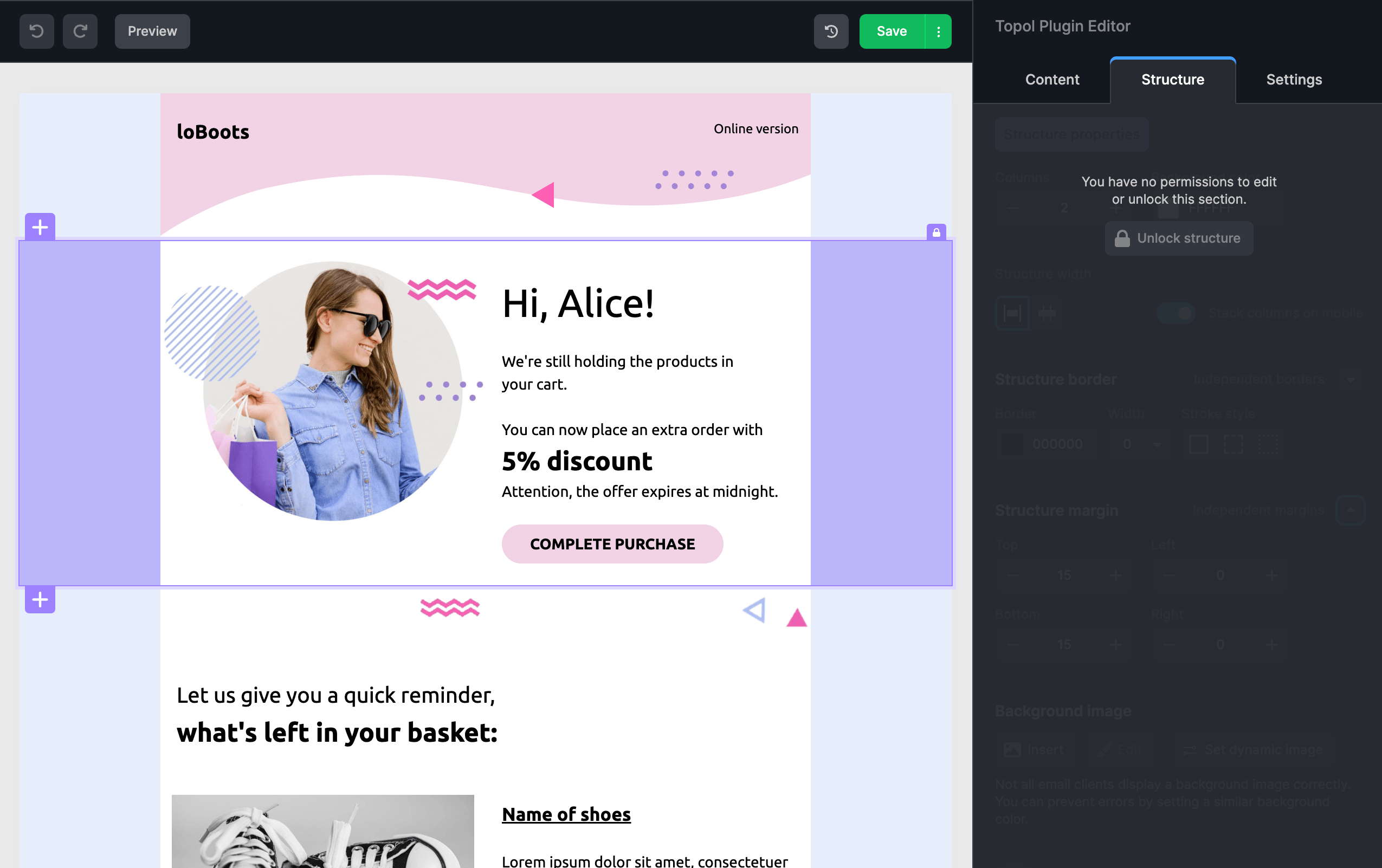
Both of these can be locked:
Structures (such as layout rows and sections)
Content (like text, images, or buttons inside a structure)
A locked item stays non-editable unless the user's role allows editing locked items.
Available user roles
Three predefined roles are available. The table below compares what each one allows:
| Capability | manager | editor | reader |
|---|---|---|---|
| Lock and unlock structures or content | Yes | No | No |
| Edit unlocked content | Yes | Yes | Yes |
| Edit locked content | Yes | Yes | No |
| Delete files in the File Manager | Yes | Yes | Yes |
| Best suited for | Admins, lead designers, or content gatekeepers | Regular team members who need to modify content but should not manage locking | Reviewers, approvers, or clients who should not alter the design |
Unlocked content is editable for every role, including reader. Locking is what the roles actually govern.
How to set a role
Roles are assigned via the role option in TOPOL_OPTIONS when initializing the editor:
ts
role: "manager" | "editor" | "reader";The value can be assigned dynamically from your own user permissions, which makes role-based access control straightforward in multi-user environments.
Overriding individual permissions
Each role carries a default set of permissions. To change a single capability without moving the user to a different role, use the optional permissions object in TOPOL_OPTIONS.
Permissions are applied on top of the selected role. The role sets the defaults first, and any flag provided in permissions overrides that default. Flags left out keep the value defined by the role.
All flags are optional booleans:
ts
role: "editor",
permissions: {
  canLockBlocks: true | false,
  canLockSections: true | false,
  canEditLockedSections: true | false,
  canEditLockedBlocks: true | false,
  canRemoveFiles: true | false,
},
WARNING
permissions is only read when a valid role is also set. Passing permissions without one of "manager", "editor", or "reader" leaves every flag at its built-in value with no error.
Each flag is described below:
| Flag | Description |
|---|---|
canLockBlocks | Whether the user can lock and unlock content blocks. |
canLockSections | Whether the user can lock and unlock structures (sections). |
canEditLockedSections | Whether the user can edit structures that are locked. |
canEditLockedBlocks | Whether the user can edit content blocks that are locked. |
canRemoveFiles | Whether the user can delete files and folders in the File Manager. When false, the delete button is hidden, even after files are selected. |
All three roles allow file removal by default, so canRemoveFiles: false is the way to prevent deleting files and folders regardless of role.
Adjusting the color theme of locked elements
Locked elements are visually marked in the editor UI, which makes the editable sections easy to distinguish.
The color of locked elements is configurable. See this guide.